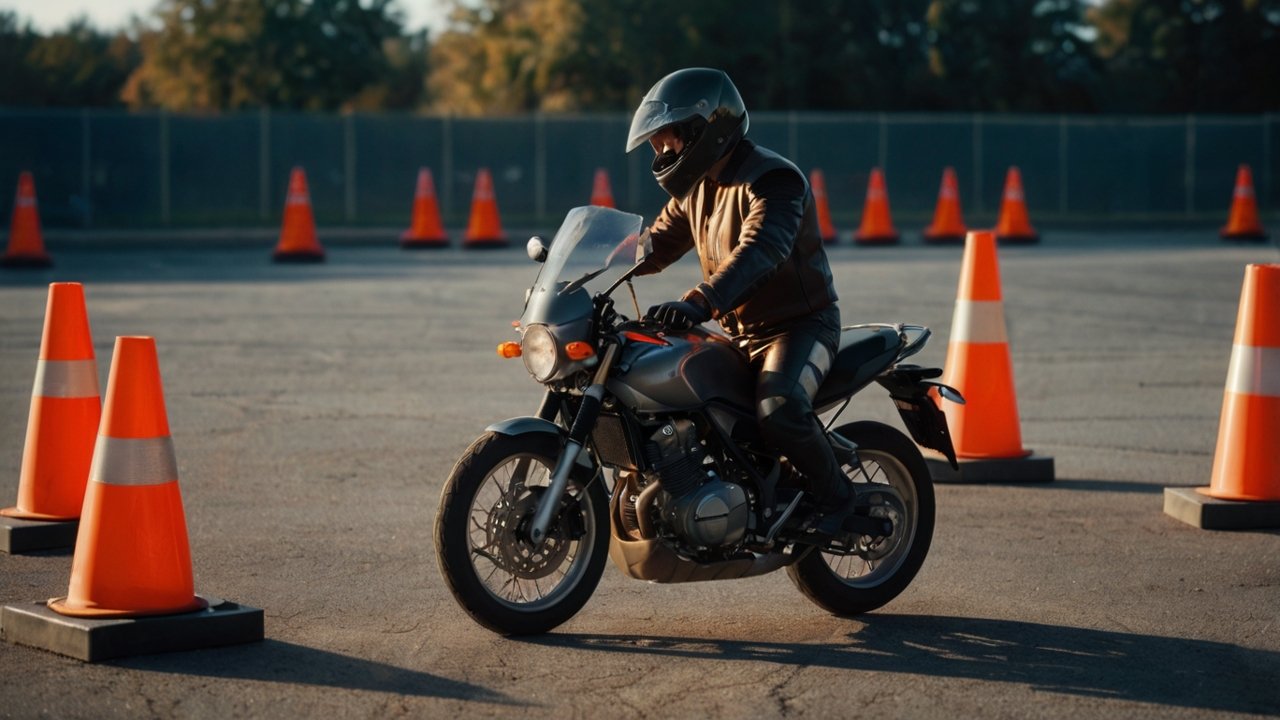
A licence proves you passed a test. Skill is what you build afterwards. These ten skills cover most of the situations that catch new riders out. Practise them in an empty car park or a quiet road — ideally after a professional training course, which no article can replace.
1. Clutch control and the friction zone
The friction zone is the part of the clutch lever's travel where the clutch starts to bite. Mastering it lets you crawl at walking pace, pull away smoothly on a hill and manoeuvre in traffic. Practise moving off and stopping again and again, using only the clutch and a steady trickle of throttle.
2. Look where you want to go
Motorcycles go where your eyes go. Stare at a pothole and you will probably hit it — this is called target fixation. Practise turning your head and looking through every turn to where you want to end up.
3. Slow-speed balance
Ride as slowly as you can in a straight line, using the friction zone, a little rear brake and your eyes fixed far ahead. Slow-speed balance is the foundation of U-turns, filtering and parking.
4. Full-lock U-turns
Turn the bars to full lock, look over your shoulder to where you want to finish, keep the revs slightly raised and control speed with the clutch and rear brake. Start with wide circles and gradually tighten them in both directions.
5. Emergency braking
Most riders have never braked as hard as their bike can. Practise in a straight line from moderate speed: squeeze the front brake progressively (don't grab it), use the rear brake too, keep your eyes up and stay upright. With ABS, keep firm pressure and let the system work.
6. Countersteering
Above walking pace, motorcycles turn by countersteering: push the right handlebar forward to lean and go right, push the left one to go left. Feel it on a quiet road with gentle pushes, then practise quicker inputs.
7. Cornering: slow, look, press, roll
A simple, widely taught sequence: slow down before the bend, look through it, press the bar to lean, then roll on the throttle gently through the corner. Doing all your braking before the turn keeps the bike stable.
8. Swerving
To avoid an obstacle, use quick countersteering inputs — and brake either before or after the swerve, never during it. Practise around a cone at moderate speed.
9. Smooth throttle and gear changes
Abrupt throttle and clumsy gear changes upset the bike, especially in bends. Practise rolling on and off smoothly and matching revs on downshifts. If your bike has a quickshifter or an automatic clutch, learn exactly how it behaves.
10. Road position and visibility
Choose a lane position that lets you see and be seen — away from the door zone of parked cars, out of blind spots and with escape routes. Assume drivers have not seen you. Bright gear and your headlight help.
A simple practice plan
| Session | Focus | Time |
|---|---|---|
| 1 | Friction zone, slow-speed balance | 30–45 min |
| 2 | U-turns, figure eights | 30–45 min |
| 3 | Emergency braking, swerving | 30 min |
| 4 | Countersteering, cornering on quiet roads | 45–60 min |
| 5 | Short traffic rides, road position | 45–60 min |
Repeat the plan every few weeks during your first season. Always wear full protective gear when practising, and check the bike before each ride with the T-CLOCS checklist.
Take it further
After a few months of riding, book an advanced or track-based course. An off-road or trial lesson is also one of the best ways to improve balance and throttle control — read more in our glossary and beginner guide.
Common beginner mistakes
- Grabbing the front brake instead of squeezing it progressively.
- Looking down at the front wheel during slow turns.
- Braking in the middle of a bend after entering too fast.
- Riding in a car's blind spot for too long.
- Riding tired, cold or rushed — when most mistakes happen.
- Trying to keep up with faster friends.
Frequently asked questions
How long does it take to feel confident on a motorcycle?
Everyone is different, but many riders feel comfortable in normal traffic after a few weeks of regular riding and noticeably more confident after their first full season. Regular short rides build skill faster than occasional long ones.
Should I practise in the rain?
Not at first. Once you are comfortable in the dry, ride in light rain on familiar roads at lower speed: brake earlier and more gently, avoid painted lines and metal covers and keep your inputs smooth.
Is an advanced riding course worth it?
Yes. A good course gives you feedback you can't get on your own and lets you practise braking and cornering in a controlled environment. Many riders call it the best money they spent after buying their gear.